ARUBA ART COLLECTION
The Collection
The Private Aruban Collection, an exquisite assemblage of works by many distinguished artists who once called this enchanting island home, is a testament to the rich artistic legacy that has thrived here over the years. This carefully curated collection is not only a celebration of Aruba's artistic heritage but also a commitment to ensuring that each masterpiece receives the attention it rightfully deserves. The decision to share these artworks throughout the passing of time reflects a profound respect for their enduring significance. By doing so, every showing becomes a moment to rekindle appreciation for the artistic brilliance that has graced Aruba, ensuring that these treasures remain ever-pending in the hearts and minds of those who encounter them.


Julie Quigley Oduber (1934 - 2001), Savaneta. 1991, Acrylic on Canvas.
Julie Quigley Oduber (1934 - 2001), Mondi. 1992, Acrylic on Canvas.
Julie Quigley Oduber (1934 - 2001), Aruban Sunset. 1994, Acrylic on Canvas.


Julie Quigley Oduber (1934 - 2001), Divi Divi Paradera. 1993, Acrylic on Canvas.
Luigi Pinedo (1926 - 2007). Natural Bridge, 1973. Oil on Canvas.
Jean George Pandellis (1896 - 1965). 1964, House at Savaneta. Oil on Wood.


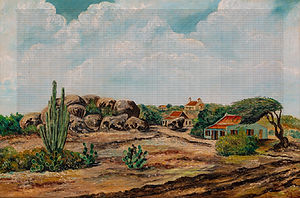
Julie Quigley Oduber (1934 - 2001), Cunucu. 1963, Oil on Wood.
Julie Quigley Oduber (1934 - 2001) x Luigi Pinedo (1926 - 2007). Arashi. 1973, Oil on Canvas.
Julie Quigley Oduber (1934 - 2001), Casibari. 1973, Oil on Canvas.


Julie Quigley Oduber (1934 - 2001), Old Natural Bridge. 1993, Acrylic on Canvas.
Julie Quigley Oduber (1934 - 2001), Harmony in Hues. 1991, Acrylic on Canvas.
Julie Quigley Oduber (1934 - 2001), Gone with the wind. 1991, Acrylic on Canvas.
Artist of the 20th Century
The 185c Stamp:
Julie Quigley Oduber was perhaps one of the most outspoken and flamboyant of the early pioneers of painting in Aruba. After settling in Aruba in the early 1950's, she soon started developing her artistic talent further, taking classes and painting with other known painters such as Pandellis and Piet Vervoord. Being one of the first to realize that Aruba lacked a proper artistic class and art production with typical Aruban character, she consequently dedicated most years of her life creating opportunities to remedy this: She developed her own painting technique and her vision to promote Aruba by means of art. A painting by Julie Oduber is instantly recognizable by her painting style and themes. Hers is a perfect, idyllic world where mankind exists in harmony with nature. The typical Aruban houses blend in seamlessly with the well balanced compositions of natural elements. The peacefulness of the scenes are enhanced by the absence of human presence or activity. The Divi-divi tree most often plays a central role, set against a background featuring the Hooiberg, rolling hills, call cacti and a final horizon formed by the Caribbean Sea. The painter uses bright, vivid colors to convey the colorfulness she experiences on Aruba, and her sweeping skies are always active with cloud formations that enliven the paintings even more. Her painting (1992, private collection) on the stamp design depicts a landscape along the north coast with three colorful Aruban houses amidst boulders and hills, flanked by a Divi-divi and cacti. Like no other painter, Julie Oduber was also active in promoting the production and marketing of Aruban art through her own gallery. and, in the reproductions of her work, she saw to it that the image of Aruba as an icon of a true Caribbean paradise was immortalized and made known to the rest of the world.
by Stan Kuiperi (2006)
The 60c Stamp:
Jean Georges Pandellis settled in Aruba (San Nicolas) during the 1930's. Being one of the first trained painters and art teachers on the island, he was very influential through his painting style and subject matter. He depicted the Aruban landscape in oil paint which he applied thickly either with a brush or palette knife. His paintings are almost always rich in texture, and in his later works he mastered an expressionistic brush stroke that differentiates his later works from his earlier ones. This is also the case of the painting represented on the stamp, "House at Savaneta" (private colection) painted in 1964. Pandellis elevated the Aruban countryside scenery, with its bright colors and sparse typical country houses to one of the favorite subjects in painting for many decades. Pandellis had many local art students, some of who became noted painters in their own right, and he always had an open and inviting attitude towards his painting. Because of his impressive legacy and his exemplary ways, Jean George Pandellis is considered to be one of the pioneers of Aruban landscape painting of the twentieth century.
by Stan Kuiperi (2006)

